





 Welcome to MetaVersus WISH!
This arena exists somewhere within a dimension where time and space have been twisted beyond recognition. Countless people arrive here, whether by choice or by force, to compete for the Glorious Trophy, said to grant any wish. Some wish to return home. Some wish to bring happiness to everyone. Others wish to plunge the world into chaos. Each challenger steps into battle, carrying their own desire in their heart. Will you be able to claim victory in this arena filled with schemes, deception, and ambition?
MetaVersus WISH is a 1-on-1 game for two players, and a deck-building game where you gradually construct your deck as the match progresses. As duelists, you begin with a basic deck made up of Stones and Daggers. As the match unfolds, you will build your deck with powerful and exciting cards that suit your strategy. The flow and strategy of the game will vary depending on the character you choose, but in most cases, your goal is to reduce your opponent’s HP to 0 or lower. Depending on the situation, you may also use Wishing Stars to cast enhanced card effects.
This guide explains how to set up and play MetaVersus WISH, along with the key terms used in the game. If this is your first duel, read through this guide and learn how the game is played!
MetaVersus WISH is an original game modded for Tabletop Simulator. You must own the game in order to play it by subscribing to the Workshop item.
 Components
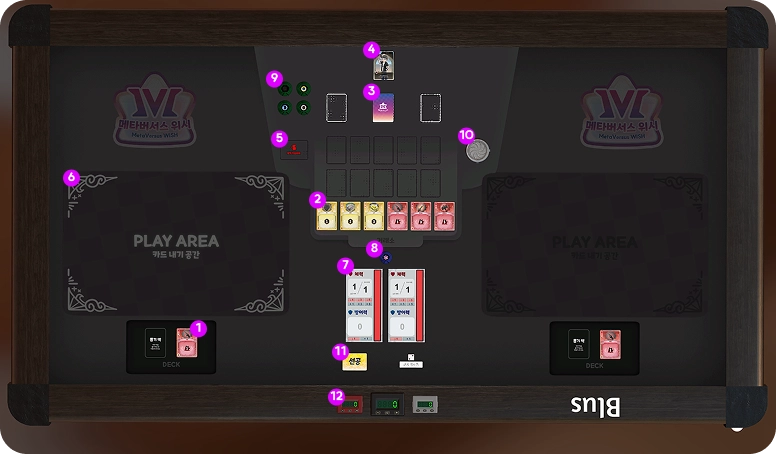
Components to Set Up by Default:
1.
2 Basic Decks
•
7 “Stone” cards and 3 “Dagger” cards
2.
6 Types of Required Market Cards
•
10 “Stone” cards, 20 “Iron” cards, and 20 “Gold” cards
•
10 “Dagger” cards, 15 “Long Sword” cards, and 20 “Warhammer” cards
•
Among the Dagger, Long Sword, and Warhammer cards, each type includes 3 cards with a cost that is 1 higher than normal. Be careful not to shuffle them together randomly.
3.
Neutral Market Cards
4.
Character Card Pile
•
Use this pile when choosing character packs.
5.
Removed Card Pile Area
•
When cards are removed from a deck, place them here.
6.
Play Area
•
Place cards here when playing them during the game.
7.
HP Counter
•
Track your HP and Max HP here.
8.
Wishing Star Token Bag
9.
Reminder Tokens
•
Use these tokens when you need to remember something. Experienced players may choose not to use them.
10.
Trash Bin
•
Place any unnecessary components here during the game.
11.
First Player Token
12.
Turn Counter
Optional Components to Set Up:
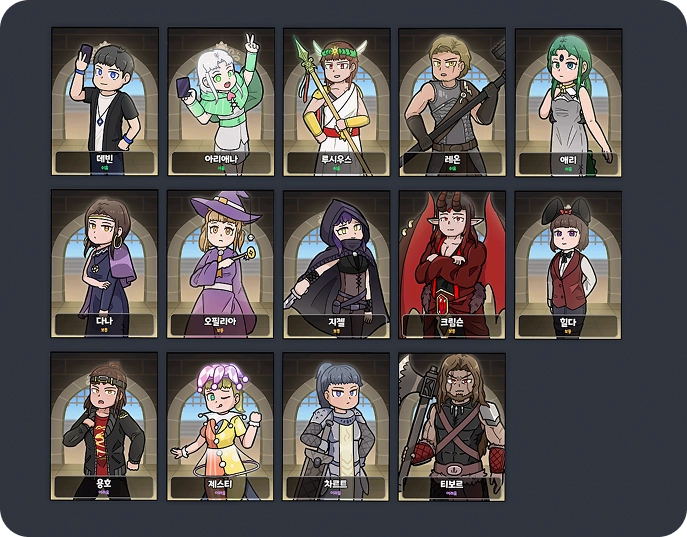

Each character pack includes the following components:
•
1 Character Card
•
1 Character Pack Summary Sheet
◦
Some character packs may include additional rules or extra setup steps. Check the summary sheet for details!
•
Usually, 8 types of Market Cards
•
Other additional components included depending on the character pack
 Match Setup
#1 Lay Out the Neutral Market Cards
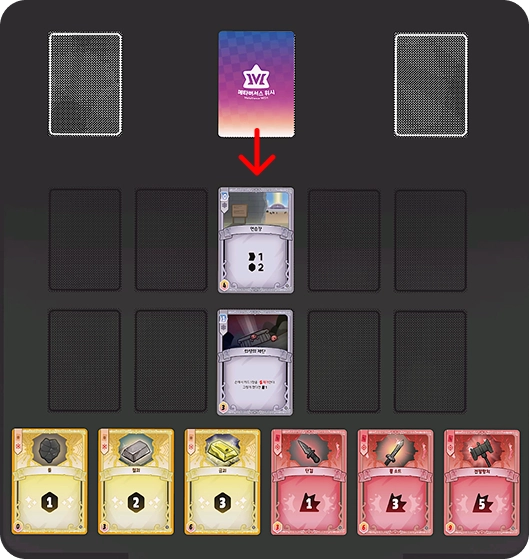
Shuffle the Neutral Market Card pile, then reveal 2 types of cards and place them in the Market.
#2 Choose Character Packs
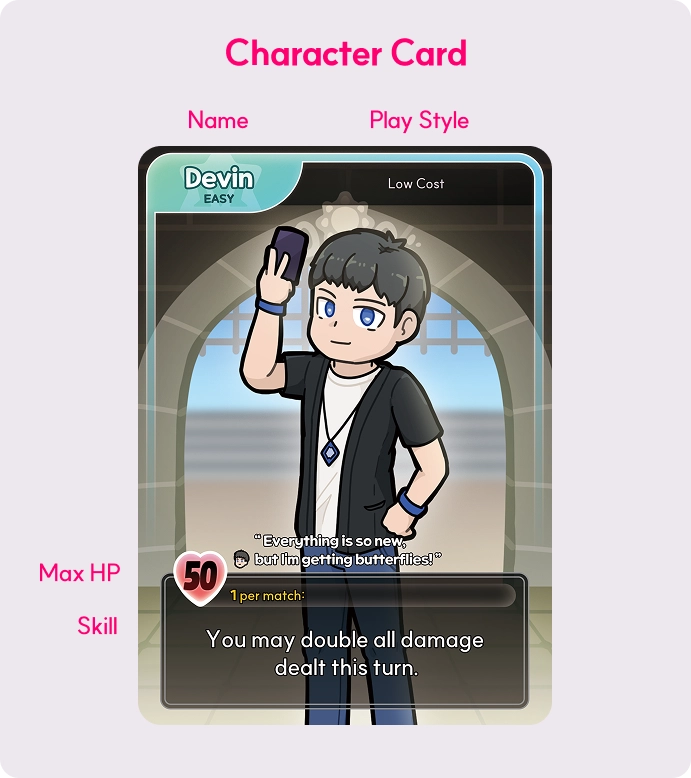
All duelists look at the revealed Neutral Market Cards, then choose the Character Pack they will use for this match. Each Character Pack differs in difficulty, the included character’s Max HP and skill, included cards, and play style/strategy. You can check the summary sheet included with each Character Pack to learn more about that pack.
Before choosing a Character Pack, you may freely lay out and read through its summary sheet and included cards at any time. However, since that pack may still be chosen later, we recommend organizing it again afterward.

Character Pack difficulty is divided into Easy, Normal, and Hard. If this is your first time playing MetaVersus WISH, try choosing a Character Pack with Easy difficulty.
Basic Selection Rules
1.
Make the Character Cards into a single pile, shuffle it, then each duelist takes 5 cards into their hand.
2.
Each duelist may ban 1 Character Pack that they do not want their opponent to choose for this match. Banned Character Packs are removed from the game. You do not have to choose a Character Pack to ban if you do not want to.
3.
Give all remaining Character Cards in your hand to your opponent.
4.
From the characters in your hand, choose 1 character to use for this match, place it face down in front of your player area.
a.
Remove any characters you did not choose from the game.
5.
Once all duelists have chosen their characters, reveal them face up, then take all components from the corresponding Character Packs.
6.
Take all components from your corresponding Character Pack.
a.
Take all included cards, except the Character Card, into your hand.
b.
If there are additional components, set them up according to the included Summary Sheet.
c.
Since your Character Card has already been set up, remove the Character Card included in the pack from the game, or place it on top of the Character Card you already set up.
d.
Place the Summary Sheet somewhere easy to see.
Variants
You may also play the match using one of the following variant rules instead.
•
Choose Character Packs from a Character Card pile that only includes a specific difficulty.
•
Shuffle the Character Card pile, then each duelist randomly draws 1 card. After that, take the corresponding Character Pack.
•
Each duelist chooses any 1 Character Pack they want from all available Character Packs.
#3 Decide the Market Cards
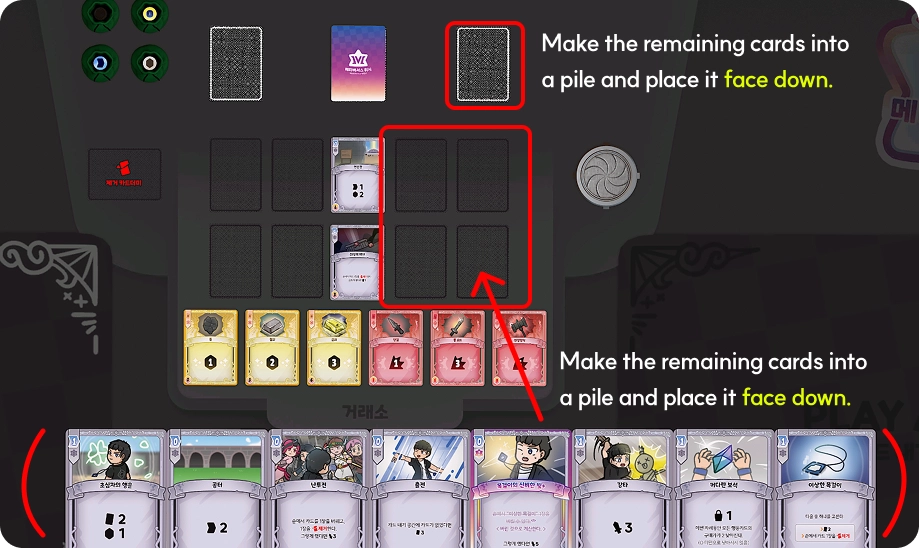
The Character Pack you took includes Character Market Cards that can be sold in the Market.
Each duelist must set up the cards they want to make available in the Market during this match. Later, both you and your opponent will be able to buy and use these cards. However, your own cards are designed to be slightly more advantageous for you.
Choose 4 types of cards you want to use during this match, place them face down in the Market, then make the remaining cards into a pile, shuffle it, and place it in your Character Card Pile area.
Think about how your cards will combine with the cards already placed in the Market, as well as your opponent’s character, and decide which cards would be best to use during this match.
#4 Stock the Market Cards
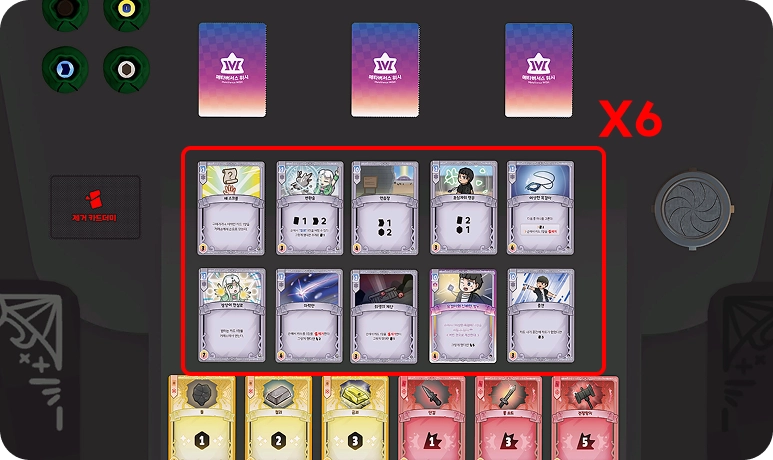
1.
Reveal all face-down Market Cards face up.
2.
Copy each Market Card until there are 6 copies of that card. This is called “stocking” the card.
a.
If a Market Card runs out during the match, reveal a new card from the card pile that card came from, then stock 6 copies of it.
i.
If a P1 Market Card sells out: Reveal 1 type of card from P1’s Character Card Pile, then stock 6 copies.
ii.
If a P2 Market Card sells out: Reveal 1 type of card from P2’s Character Card Pile, then stock 6 copies.
iii.
If a Neutral Market Card sells out: Reveal 1 type of card from the Neutral Market Card Pile, then stock 6 copies.
iv.
If the Neutral Market Card Pile runs out: Continue the match.
#5 Determine the First Player
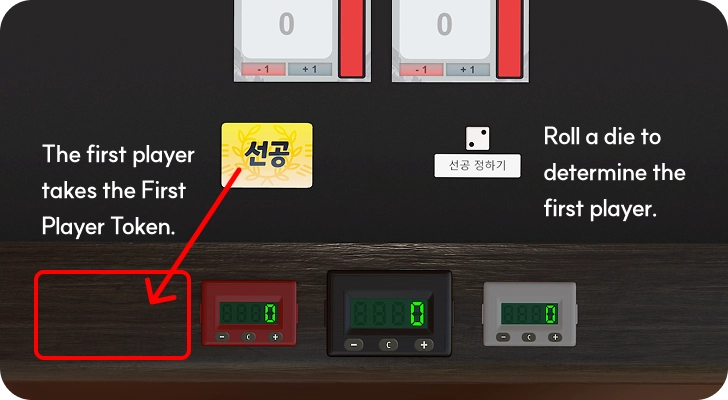
Roll the First Player Die to determine the first player. If one of the duelists is playing their first match, that duelist starts as the second player.
The first player takes the First Player Token and places it at the lower-left side of their HP Counter if they are P1, or at the lower-right side if they are P2.
#6 Start the Match
Each duelist enters the HP and Max HP shown on their Character Card into their HP Counter.
Then, each duelist shuffles the Basic Deck in their player area, places it face down in their Draw Deck area, and draws 5 cards from their deck into their hand.
Once both duelists have drawn their cards, the first player begins Turn 1.
 Playing the Match
Overview
In general, the match progresses as the two duelists deal damage to each other. If any duelist’s HP becomes 0 or lower at any time, continue playing until the second player’s turn is completed, then end the match. At this time, HP can go below 0. When the match ends, the duelist with the higher remaining HP wins. If both duelists have the same HP, the first player wins.
A turn proceeds in the following order. Except for the Discard Phase, each phase may be performed or skipped.
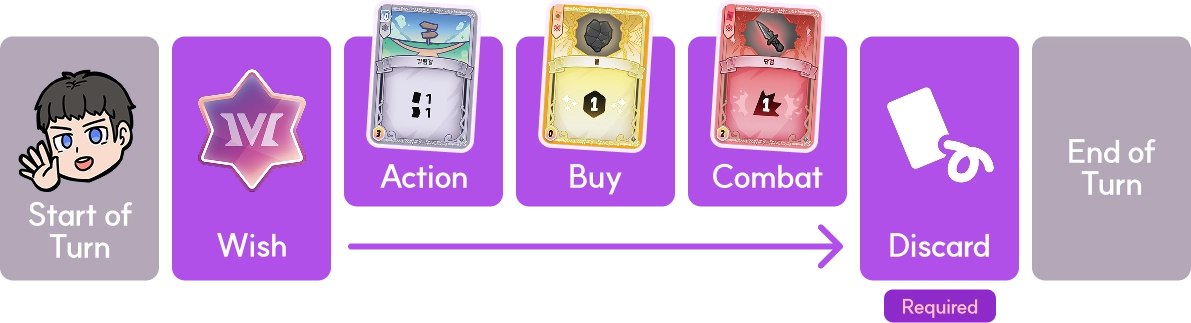
Wish Phase

Wishing Star
During the Wish Phase, you may gain 1 Wishing Star.
•
If you gain a Wishing Star during this phase, immediately skip to the Discard Phase.
•
If you do not gain a Wishing Star, continue to the Action Phase as normal.
Wishing Stars you have do not disappear when your turn ends. However, you can have up to 3 Wishing Stars. If you would gain more than 3 Wishing Stars, any Wishing Stars beyond 3 disappear.
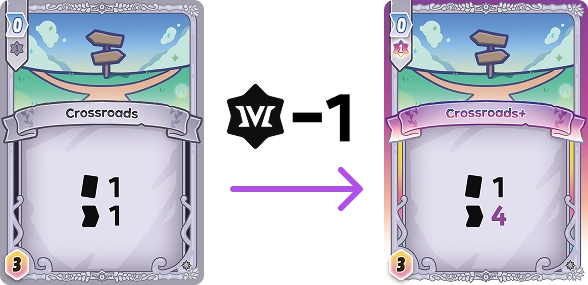
By using a Wishing Star, you can transform a card into a much more powerful version for one use!
•
The card’s ability may be enhanced,
•
its AP cost may be reduced,
•
or the conditions required to cast its effect may become easier to meet, or disappear entirely.
To cast a Wishing Star effect, spend the instructed number of Wishing Star tokens immediately before playing the card. Then, change the card’s state and play it.
To change a card’s state, right-click the card and select State, or use the Page Up / Page Down shortcut keys.
Wishing Star Notes
•
Required Market Cards, such as Stone, Iron, Gold, Dagger, Long Sword, and Warhammer, cannot use Wishing Stars.
•
Wishing Stars can only be used immediately before playing a card. If you cast another card’s effect or play another card through a card effect, you cannot use a Wishing Star on the card played together with it.
•
You may use multiple Wishing Stars during a single turn.
•
A Wishing Star effect is cast only on the 1 card played immediately after using the Wishing Star. Unless otherwise instructed, it is not cast on other cards with the same name.
•
When a card is transformed by a Wishing Star, a + is added after the card name. However, the original card and the card with + added are still treated as cards with the same name.
Action Phase
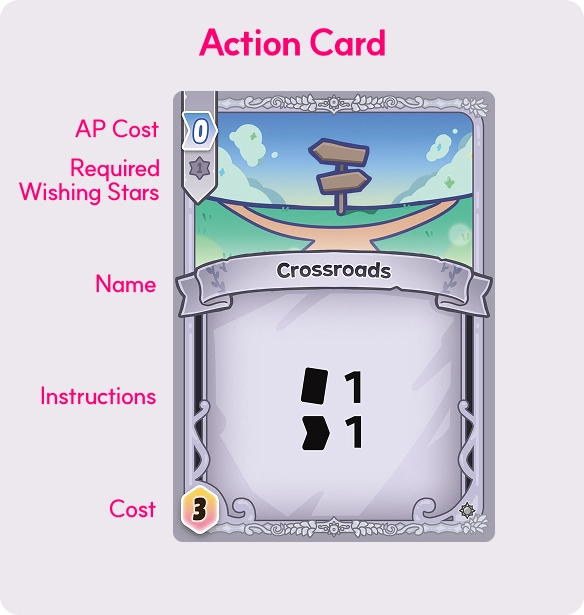
When the Action Phase begins, you gain 1 AP and may play Action Cards from your hand. Action Cards are gray cards with a large rectangular frame.
To use an Action Card, place it from your hand into the Play Area in front of you and reveal it to your opponent.
If the Action Card has an AP cost of 1 or higher, you must lose that much AP in order to play it. If you do not have enough AP, you cannot use that Action Card.
You can gain AP through effects such as other Action Cards that instruct you to gain additional AP(+X AP). There is no limit to how much AP you can gain during a turn, but any unused AP disappears when the turn ends.
You may also choose not to play Action Cards in your hand for strategic reasons. Any Action Cards you do not play are discarded to your Discard Deck during the Discard Phase.
When you play a card, follow its instructions from top to bottom in order. If there is a dividing line, only cast the instructions above the line for now. Follow the text below the line only when its condition is met. Refer to the text written on each card for details. You may still use an Action Card even if you cannot cast all of its instructions. However, any instructions that must be followed must be cast. Icons and terms written in card instructions are explained later in the Keywords and Terms section.
If you want to cast another effect, you must finish resolving the effect you are currently casting first. This applies not only to Action Cards, but also to Currency Cards, Weapon Cards, character abilities, and other effects described later. Unless specifically stated otherwise, you cannot play another Action Card while following the instructions of an Action Card. However, in some cases, another effect may be cast while a card effect is being resolved, such as through an Instant effect.
Buy Phase
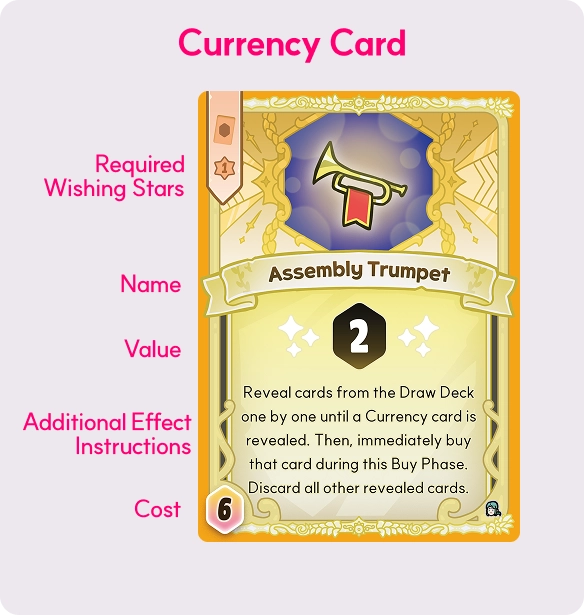
When the Buy Phase begins, you may play any number of Currency Cards from your hand, in any order. Currency Cards are yellow cards with a hexagonal frame.
To use a Currency Card, place it from your hand into the Play Area in front of you and reveal it to your opponent. Then, gain Gems equal to the number shown in the icon in that card’s lower instruction box. This is called the Currency Card’s Value. You do not gain Gems equal to the card’s cost in the lower-left corner!
If there are any effects instructed after the Value, follow them from top to bottom in order. You do not have to play every Currency Card in your hand. However, you only gain Gems from the Currency Cards you play.
Once you have played as many Currency Cards as you want, you may buy 1 card from the Market. The number of Gems required to buy a card is shown by its cost in the upper-left corner. You may buy a card with a cost less than or equal to the total number of Gems you gained this turn from additional Gems (+X Gems) and the Gems you just gained by playing Currency Cards.
To buy a card, choose 1 card from the Market and gain it. To gain a card means to take a card from the instructed location and add it to your deck. Unless otherwise instructed, place the card you bought and gained into your Play Area. Cards you gain this way cannot be used immediately unless specifically instructed otherwise. You will be able to use them later after drawing them from your Draw Deck and playing them.
When you buy a card, reduce your current Gems by that card’s cost. Even after you buy a card, unless a specific instruction says otherwise, the Currency Cards you played do not disappear. They are discarded to your Discard Deck and remain in your deck.
By default, you can buy only 1 card from the Market. However, if you played a card with an effect that gives additional buys (+X Buy) during the previous Action Phase, you gain the opportunity to buy and gain X additional cards as instructed. Buying cards is not required. Even if you have multiple buy opportunities, you may choose to buy only once, or skip buying entirely.
Cards with a cost of 0 Gems, such as Stone, can be gained using 1 buy without spending any Gems.
Once you buy a card, you can no longer play any more Currency Cards. After you finish buying, move on to the next phase.
Combat Phase
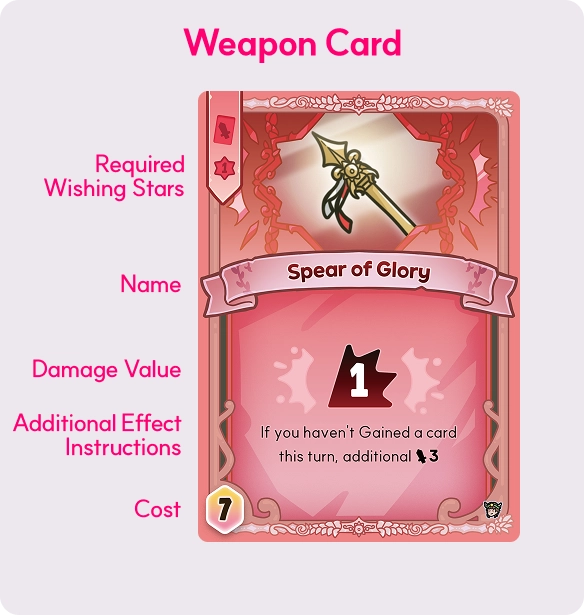
When the Combat Phase begins, you may play any number of Weapon Cards from your hand, in any order. Weapon Cards are red cards with a star-shaped frame.
To use a Weapon Card, place it from your hand into the Play Area in front of you and reveal it to your opponent. Then, deal damage to your opponent equal to the number shown in the icon in the instruction box. This is called the Weapon Card’s Damage Value.
If there are any effects instructed after the Damage Value, follow them from top to bottom in order. You do not have to play every Weapon Card in your hand. However, you only deal damage with the Weapon Cards you play.
Once you have played as many Weapon Cards as you want, deal damage to your opponent equal to the total Damage Value of all Weapon Cards you played. This damage is not dealt separately for each Weapon Card. Instead, it is treated as being dealt all at once. Use the button on the HP Counter to reduce your opponent’s HP by the total Damage Value.
After you have played all the Weapon Cards you want and dealt damage to your opponent, you can no longer play any more Weapon Cards. Finish your attack, then move on to the next phase.
Discard Phase
Discard all cards — including cards you played, cards you gained, cards remaining in your hand, and cards in your Play Area — to your Discard Deck.
As an exception, some cards may not be discarded. In that case, follow the instructions written on the card, such as placing it outside the Play Area. The order in which you place cards into your Discard Deck does not matter.
Then, draw 5 cards from your Draw Deck into your hand. If there are not enough cards to draw, first draw as many cards as you can. Then, shuffle your Discard Deck to make a new Draw Deck, and continue drawing until you have drawn the remaining number of cards. If there are not enough cards to make a new Draw Deck, draw as many cards as you can.
There is an automatic setup feature. In Tabletop Simulator, pressing the End Turn button automatically discards the cards in your Play Area to your Discard Deck, then draws cards until you have 5 cards in your hand.
After this, the turn passes to your opponent. Any AP, additional buys, and Gems you did not use during this turn disappear.
Casting Character Skills
While playing the match, all duelists may cast the skill of the character they chose. To cast means to “follow the instructed effect.”
Character skills are broadly divided into Active and Passive skills. Unless a specific subject is stated, the duelist who chose that character is treated as the one casting the effect. Unless a specific duration is stated, the effect lasts for the current turn in which it was cast. To cast a skill, declare “I will cast/use my character’s skill,” or clearly show your opponent that you have used the effect, then follow its instructions. For Passive effects, if your opponent is already aware of the ability, you do not have to repeat these declarations every time. However, doing so is not recommended.
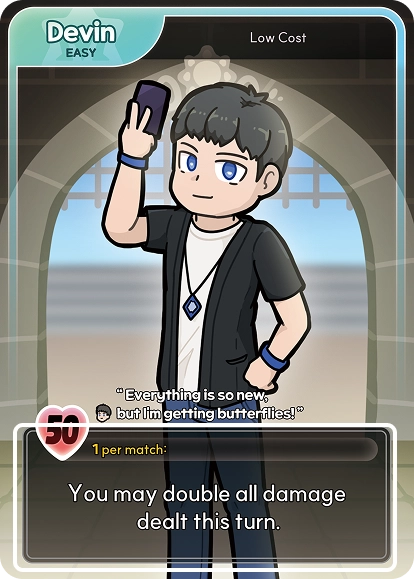
Unless a skill has a condition that requires a specific situation, such as “during a specific turn/phase” or “whenever you follow a specific instruction,” its effect can be cast at any time. Abilities written as “may be cast” can be skipped for strategic reasons, even if their condition is met. If you did not cast any ability, and that character ability has a limited number of uses, the remaining number of uses is not reduced. Instructions written as “is cast” must be followed if possible.
Some skills have a limited number of uses. You can use the Reminder Tokens prepared above the Market to keep track of the number of uses. If there is no limit, you do not need to do this.
Character skills are not counted as the effects of Action Cards, Weapon Cards, or Currency Cards.
 End of the Match
If any duelist’s HP becomes 0 or lower at any time during a turn, continue playing until the second player’s turn is completed, then end the match. Even if that duelist recovers HP after their HP becomes 0 or lower, the match must still end. After the match ends, the duelist with the higher remaining HP wins. If both duelists have the same remaining HP, the first player wins.
If an effect that says “win/lose the match” is cast, ignore the condition above and that duelist immediately wins or loses as instructed. These special win/loss effects are rarely included in certain Character Packs.
 Appendix
Introduction to Keywords and Terms
Terms and Keywords Used in MetaVersus WISH (Expand to View)
Making a Draw Deck
During the match, if you need to cast an effect but do not have enough cards in your Draw Deck, shuffle the cards in your Discard Deck to make a new Draw Deck. When this happens, cards that you played or gained immediately before making the Draw Deck may be included in the new Draw Deck. Place the newly made card pile underneath any cards that were still remaining in your Draw Deck, and flip the face-up Discard Deck face down to make it into the Draw Deck. After making the Draw Deck, continue following the instruction you were trying to resolve.
You need cards from your Draw Deck in the following situations:
•
When you need to take cards from your Draw Deck, such as when drawing cards
•
When you need to check or reveal cards from your Draw Deck
•
When you need to set aside cards from your Draw Deck
•
When you need to discard or Remove cards from your Draw Deck
If there are not enough cards to make a Draw Deck, use only the cards that are available. Also, you only shuffle your Discard Deck to make a new Draw Deck when your Draw Deck has no cards in it, meaning it has 0 cards. You may not make a new Draw Deck on your own while there is still 1 or more card remaining in your Draw Deck. You also may not make a new Draw Deck on your own when your Draw Deck has no cards, unless you are in a situation where cards from the Draw Deck are needed.
Other Rules
•
When following instructions from card effects, character skills, and similar effects, if no specific subject is stated, the duelist who cast the effect is treated as the one carrying out the instruction.
•
When following instructions from card effects, character skills, and similar effects, if no specific duration is stated, the effect lasts for the turn in which it was cast.
•
If you want to cast another effect, you must first finish resolving the effect you are currently casting, such as a card effect or character ability. Unless an instruction such as Instant requires you to interrupt the current instruction, you cannot stop resolving an instruction on your own to cast another effect.
•
Anything that all duelists can check, such as cards stocked in the Market or cards played face up, is public information.
•
You may check the cards in your own or your opponent’s Discard Deck and Removed Card Pile at any time.
•
When you need to return multiple cards, unless otherwise instructed, you may return them in any order you want.
•
If multiple instructions would cause 2 or more types of actions to happen at the same time, and no specific order is instructed, that duelist may carry them out in any order they want.
•
If an unclear situation occurs during the match, discuss it with each other and decide how to handle it. You may also contact us through the inquiry channel about the issue. We will continue improving the rules through future updates.
Credits and Contact
•
Creator: Blus(블러스) (Discord: @blus)
◦
Inquiry Email: teamcrescendo@naver.com
•